


 English
WT99C262-SG3 Feature Introduction
2026-05-12
Update history
| Date | Version | Author | Update content |
|---|---|---|---|
| 2026-05-12 | 1.0.1 | Yobie Zhou | Added board images and purchasing links |
| 2025-06-19 | 1.0.0 | Kirto | Initial document release |
1. Introduction
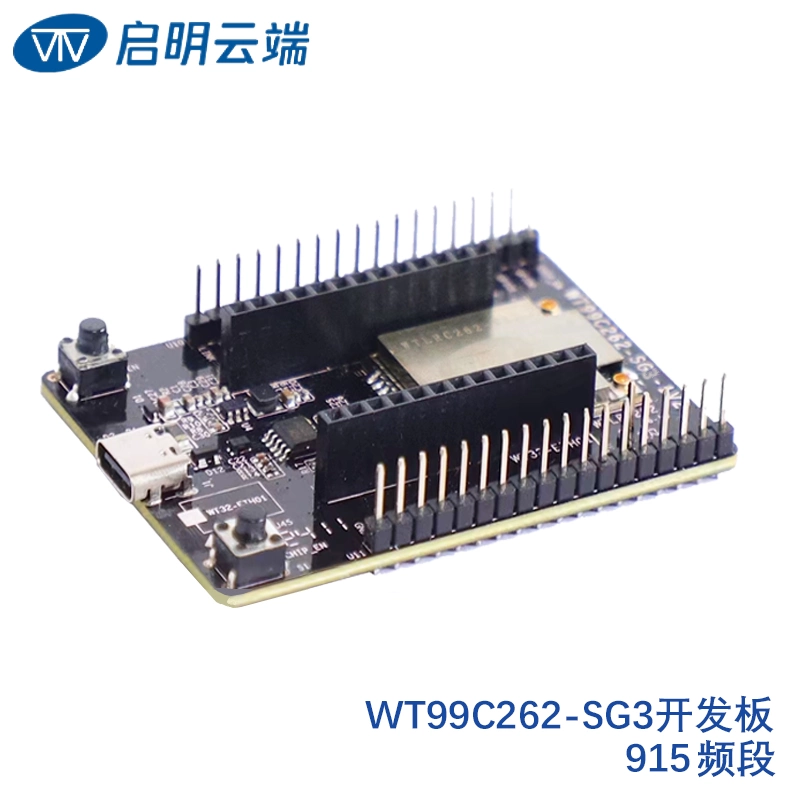
The WT99C262-SG series development board is a development board launched by Shenzhen Wireless-tag Co., Ltd., based on the WTLRC262-SG series module. The onboard module supports Wi-Fi + BLE + LoRa functionality, and most of the module's pins are brought out to pin headers on both sides. Developers can connect various peripherals via jumpers according to actual needs, or use the development board on a breadboard. Additionally, the WT99C262-SG series development board can be paired with Wireless-tag's WT32-ETH series development boards to achieve LoRa/Wi-Fi/BLE to Ethernet functionality.
Buy Now: WT99C262-SG3 Development Kit
1.1 🔧 Core Hardware Configuration
- Communication Module: Onboard Wireless-tag's self-developed
WTLRC262-SGseries module, integrating three major wireless communication protocols:Wi-Fi,BLE, andLoRa. It features long-range, low-power consumption, and high-connection capacity, suitable for various IoT scenarios. - Pin Expansion: Most of the module's
GPIOsare brought out to pin headers on both sides, facilitating users to connect peripherals via jumpers or directly plug the development board into a breadboard for rapid prototyping and debugging. - Multi-Protocol Intercommunication: Can be used with Wireless-tag's
WT32-ETHseries Ethernet modules to buildLoRa/Wi-Fi/BLE↔Ethernetgateways, enabling data passthrough and interconnection between various network protocols. - Hardware Flexibility: The development board features a compact structure and rich interfaces, suitable for building wireless sensor networks, remote data acquisition, industrial edge nodes, and other application scenarios.
1.2 🛠️ Design Features
- Combination of
Wi-Fi + BLE + LoRa. Suitable for development in application scenarios such as industrial control. - Onboard programming chip: Uses
CH342KUSBto serial chip. Only a standardType-Ccable is needed for programming and debugging. - Can be paired with
WT32-ETHto achieve communication with Ethernet. - Both antennas use
IPEXexternal antenna connectors, facilitating the use of external antennas with better signal quality. - Reset buttons for both
WTLRC262-SGandWT32-ETHare brought out, making development more convenient.
1.3 📡 Main Application Scenarios
- Smart Agriculture: LoRa supports long-range, low-power transmission, suitable for off-grid or wide-area environments;
Wi-Fi/Ethernetcan backhaul data to the cloud platform. - Industrial IoT: Supports integration of multiple protocols; can quickly connect to existing Ethernet networks via
WT32-ETHmodules. LoRato Ethernet Data Relay Gateway: Bridges edge nodes to central servers, suitable for smart water meters, electricity meters, manhole cover monitoring, etc. Ultra-low cost, high cost-effectiveness.- Smart Buildings: Supports multi-protocol convergence; Wi-Fi or Ethernet methods can directly connect to local servers or building automation platforms.
1.4 ⚙️ Development Advantages
- Development using
esp-idf, open-source official examples available for reference. - More convenient development when paired with
WT32-ETH. OTAUpgrade: Supports remote firmware updates, offering high maintenance convenience.
2. Pin Description
| Name | Function |
|---|---|
| CHIP_EN | Chip enable pin |
| GPIO0 | General Purpose IO 0 |
| GPIO1 | General Purpose IO 1 |
| GPIO2 | General Purpose IO 2 |
| GPIO8 | General Purpose IO 8 |
| EN1 | Debug/Programming Interface: Enable, active high |
| GND | Debug/Programming Interface: Ground |
| VCC_3V3 | Reserved Debug/Programming Interface: 3.3V |
| EN | Enable, active high |
| CFG | IO32, CFG |
| 485-EN | IO33, RS485 enable pin |
| RXD2 | IO5, RXD2 |
| TXD2 | IO17, TXD2 |
| GND | Ground |
| VCC_3V3 | 3.3V power supply |
| GND | Ground |
| NC | 5V power supply (Note: NC might imply not connected or no connection in some contexts, but here it's listed as a 5V supply point. Verify usage.) |
| LINK | Network link indicator LED pin |
| 3V3 | 3.3V power supply |
| GND | Ground |
| C2_UTXD | U0TXD, GPIO20 |
| C2_URXD | U0RXD, GPIO19 |
| GPIO9 | General Purpose IO 9 |
| UTXD | Debug/Programming Interface: IO1, TXD0 |
| URXD | Debug/Programming Interface: IO3, RXD0 |
| IO0 | Debug/Programming Interface: IO0 |
| GND | Ground |
| IO39 | IO39, input only |
| IO36 | IO36, input only |
| IO15 | General Purpose IO 15 |
| IO14 | General Purpose IO 14 |
| IO12 | General Purpose IO 12 |
| IO35 | General Purpose IO 35, input only |
| IO4 | General Purpose IO 4, input only |
| IO2 | General Purpose IO 2, input only |
| GND | Ground |
3. Power Characteristics
You can choose one of the following power supply methods for the WT99C262-SG series development board:
- External power supply via the
USB Type-Cinterface; - Use the
3V3power input port and connect the corresponding voltage via Dupont wires; - When used with the
WT32-ETHseries development board, it can be powered via theWT32-ETHseries development board. (Currently supportsWT32-ETH02,WT32-ETH02-PLUS);