


 English
WT9932C5-TINY Feature Introduction
Update history
| Date | Version | Author | Update content |
|---|---|---|---|
| 2026-05-12 | 1.0.1 | Yobie Zhou | Added board images and purchasing links |
| 2025-12-05 | 1.0.0 | Kirto | Initial document release |
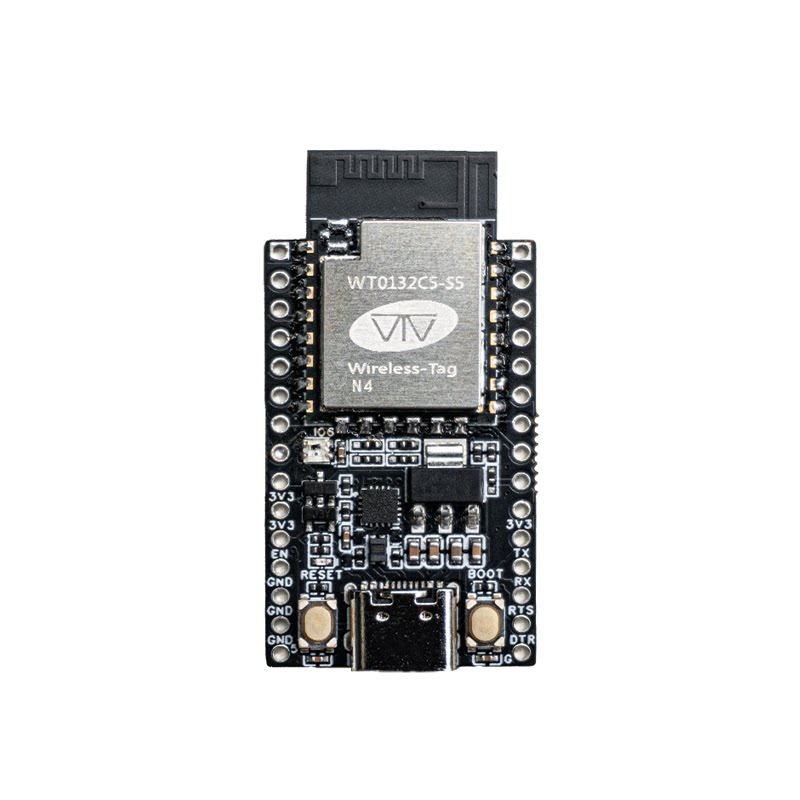
1. Introduction
In the TINY series from wireless-tag, WT9932C5-TINY is a high-performance and lightweight development board based on Espressif’s new-generation ESP32-C5. It is designed for IoT wireless communication, smart home devices, and high-concurrency application scenarios. The ESP32-C5 adopts a single-core 32-bit RISC-V architecture with a maximum frequency of 240 MHz, achieving an excellent balance between performance and power consumption. Compared with previous generations, the ESP32-C5 supports advanced Wi-Fi 6 (802.11ax) and Bluetooth 5.3, providing significant improvements in throughput, latency, anti-interference capability, and connection stability—ideal for multi-device parallel wireless networks.
The chip features built-in hardware encryption engines, secure boot, and other security mechanisms, making it suitable for security-critical devices such as smart locks and access control systems. As a compact open-source development board, WT9932C5-TINY integrates a USB-to-serial converter, an RGB indicator LED, RESET/BOOT buttons, and exposes all available IO pins. It also supports switching to a USB-to-serial tool by shorting EN and GND. With a compact PCB size of just 23 × 38 mm, it still offers a 1A LDO regulator output and a well-organized interface layout, providing an efficient and convenient development experience for learning, prototyping, and mass production validation.
Buy Now: WT9932C5-TINY Development Kit
1.1 🔧 Core Hardware Specifications
- Main Controller: ESP32-C5 (32-bit RISC-V, up to 240 MHz)
- Module: WT0132C5-S5 (integrated ESP32-C5 chip)
- Wireless: Wi-Fi 6 (802.11ax) + Bluetooth 5.3 dual-mode
- USB-to-Serial: On-board CH343P
- Buttons: RESET, BOOT (supports flashing mode)
- LED: 1 × WS2812 RGB LED (IO6)
- Power: LDO regulator, up to 1A output
- Interface: Dual-row 15P × 2 (30 pins total), all GPIOs fully exposed
- Connectors: USB-C, 2.54 mm pin headers (breadboard-friendly)
- Debug Mode: Short EN to GND to switch into USB-TTL mode
1.2 🛠️ Design Highlights
- Compact size (PCB: 23 × 38 mm), highly integrated: ESP32-C5 module, USB-to-serial, power system, RGB LED, and buttons all integrated into a small footprint—ideal for space-constrained IoT applications.
- Enhanced wireless capability: With dual-band Wi-Fi 6 and Bluetooth 5.3, it offers superior throughput, lower latency, and improved anti-interference over ESP32-C3/C2 series—suitable for smart home, remote communication, and data transmission.
- Convenient debugging, dual-purpose design: On-board CH343P eliminates the need for an external serial adapter; shorting EN and GND turns the board into a USB-to-serial tool.
- Improved status and function monitoring: On-board RGB LED, power indicator, and RESET/BOOT buttons help with network indication, program testing, and entering download mode.
- Stable power and expandability: 1A LDO ensures stable power for sensors and peripherals; all GPIOs are exposed for prototyping and expanded development.
1.3 📡 Typical Application Scenarios
- High-concurrency smart home devices
Such as gateways, smart panels, and wireless repeaters, leveraging Wi-Fi 6 for more stable multi-device connectivity. - Mid-to-long-range wireless communication devices
Enhanced anti-interference and low-latency performance are suitable for industrial control and long-range sensing nodes. - Prototyping and educational projects
Complete interfaces and RGB indication make it ideal for IoT courses, research projects, and rapid prototyping. - USB-to-Serial debugging tool
Short EN-GND to use it as a USB-TTL device for debugging other MCU modules.
1.4 ⚙️ Development Advantages
- Supports Wi-Fi 6 and BLE 5.3 with higher throughput, lower latency, and better anti-interference
- On-board CH343P enables one-cable USB-C debugging
- All GPIOs exposed for sensor/peripheral expansion
- RGB LED available for example projects, status indication, and debugging
- EN-GND shorting switches board into USB-TTL mode for tool reuse
- Small size, low power, low cost—ideal for mass production validation and long-term deployment
- Full support for ESP-IDF, Arduino, FreeRTOS, and other ecosystems
2. Pin Description
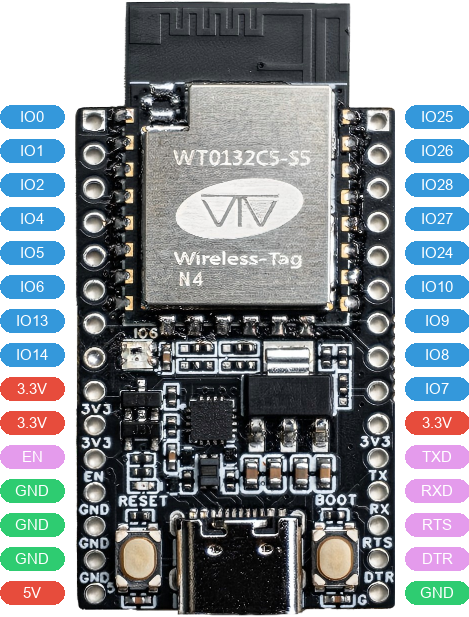
2.1 Left Side Pins
| No. | Pin | Description | Voltage | Note |
|---|---|---|---|---|
| 1 | IO0 | General-purpose IO 0 | 0V/3.3V | |
| 2 | IO1 | General-purpose IO 1 | 0V/3.3V | |
| 3 | IO2 | General-purpose IO 2 | 0V/3.3V | |
| 4 | IO4 | General-purpose IO 4 | 0V/3.3V | |
| 5 | IO5 | General-purpose IO 5 | 0V/3.3V | |
| 6 | IO6 | General-purpose IO 6 | 0V/3.3V | RGB LED |
| 7 | IO13 | General-purpose IO 13 | 0V/3.3V | |
| 8 | IO14 | General-purpose IO 14 | 0V/3.3V | |
| 9 | 3.3V | Power output | 3.3V | |
| 10 | 3.3V | Power output | 3.3V | |
| 11 | EN | Reset pin | 0V | |
| 12 | GND | Ground | 0V | |
| 13 | GND | Ground | 0V | |
| 14 | GND | Ground | 0V | |
| 15 | 5V | Power output | 5V |
2.2 Right Side Pins
| No. | Pin | Description | Voltage | Note |
|---|---|---|---|---|
| 1 | IO25 | General-purpose IO 25 | 0V/3.3V | |
| 2 | IO26 | General-purpose IO 26 | 0V/3.3V | |
| 3 | IO28 | General-purpose IO 28 | 0V/3.3V | |
| 4 | IO27 | General-purpose IO 27 | 0V/3.3V | |
| 5 | IO24 | General-purpose IO 24 | 0V/3.3V | |
| 6 | IO10 | General-purpose IO 10 | 0V/3.3V | |
| 7 | IO9 | General-purpose IO 9 | 0V/3.3V | |
| 8 | IO8 | General-purpose IO 8 | 0V/3.3V | |
| 9 | IO7 | General-purpose IO 7 | 0V/3.3V | |
| 10 | 3.3V | Power output | 3.3V | |
| 11 | RXD | CH343P UART RX | 0V/3.3V | |
| 12 | TXD | CH343P UART TX | 0V/3.3V | |
| 13 | RTS | CH343P UART flow control | 0V/3.3V | |
| 14 | DTR | CH343P UART flow control | 0V/3.3V | |
| 15 | GND | Ground | 0V |
3. Power Characteristics
You may power the WT9932C5-TINY series development board using any of the following methods:
- Supply power via the
USB Type-Cinterface - Use Dupont wires to connect to the
VCCpower input - Use Dupont wires to connect to the
5Vpower input